
In short
- Virtual staging adds digital furniture and styling to a photo of a real, empty room.
- It helps with empty apartments, new builds, homes emptied before a sale and rooms whose use is unclear.
- It is not used to hide damage or to change permanent features such as walls, windows, floors or the view.
- Every such image is labelled as a digital visualisation, and the real photo of the room stays in the listing.
- It costs from €25 + VAT per final image and can be done remotely, on suitable photos.
What virtual staging is, and what it is not
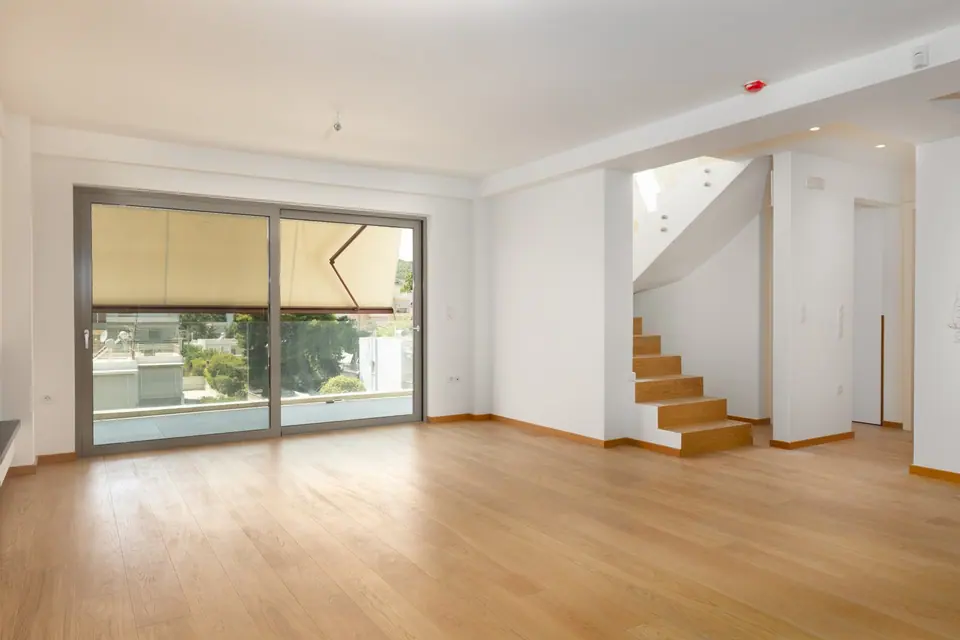
It is digital furnishing: furniture, lighting and decor are added to the photo of an empty room, in a style agreed in advance. The viewer can then see the scale of the room and one possible way to use it.
It is not a 3D render with measured geometry. A visualisation made from a photo is different from modelling with real dimensions. If you need controlled geometry, for example for a project that has not been built yet, the right choice is a 3D render from drawings.
Virtual renovation is also different: it shows indicative changes of materials, colours and decor in an existing room. It is a visual idea, not an architectural study or a technical solution.
When does digital furnishing help?
In a photo, an empty room often looks smaller and colder than it is, because nothing shows its scale. That is where staging makes the biggest difference:
| Case | What virtual staging solves |
|---|---|
| Empty apartment for sale or rent | It shows how much furniture fits, and therefore how practical the space is |
| New build without a furnished show unit | It adds warmth and scale to rooms with new but bare finishes |
| Room with an unclear use | It answers "nursery or home office?" by showing one realistic option |
| Property that needs refreshing | Virtual renovation shows a possible new look, next to the actual condition |
| Office or commercial space | It shows a possible layout of workstations or a reception area |
For new builds in particular, see also our guide on photographing new-build apartments.
When is it not a good fit?
- In a furnished property. Tidying before the shoot, or selective removal of movable objects from the images, helps more.
- To hide damage. Damp, cracks or old window frames are not "fixed" digitally. The buyer will see them at the viewing and trust is lost.
- For short-term rentals. An Airbnb guest expects to find exactly what they saw. That calls for real photos of the real furnishing, as explained on our Airbnb photography page.
How do you present virtual staging honestly?
Digital furnishing is useful as long as the viewer knows what they are looking at. Follow these rules:
- Label every image as a "Digital visualisation", on the image or in its caption.
- Keep the real photo of the same room in the listing, ideally right before or after it.
- Do not change permanent features: walls, openings, floors, the view or the size of the room.
- Use furniture at a realistic scale, so the room does not look bigger than it is.
- Check the rules of the platform where you publish the listing regarding edited images.
If you are considering a staged image for the cover, read our guide on choosing the cover photo for a property listing first.
What do the photos need?
The result of staging depends on the photo it is built on. A dark or tilted shot will not become convincing however much furniture is added. A suitable photo is:
- horizontal and wide, so most of the room is visible;
- bright, with the windows correctly exposed;
- shot with straight vertical lines on walls and window frames;
- of an empty, clean room, without materials, boxes or tools.
Digital work is done remotely, so we can also work on photos you already have, as long as they are suitable. If they are not, HDR photography from €129 + VAT gives you both the real listing images and the right base for staging.
How much does virtual staging cost?
It is charged per final image. Prices are starting points excluding VAT:
| Service | Price excl. VAT | What it includes |
|---|---|---|
| Virtual Staging | from €25 / final image | Digital furnishing of an empty room |
| Virtual Renovation | from €40 / final image | A visual renovation idea from a photo |
| Selective object removal | from €10 / image | Movable objects only, not damage or permanent features |
| Day-to-Dusk | from €15 / image | A digital evening look, clearly stated as an edit |
You do not need to stage every room. Two to four images are usually enough: the living room, the main bedroom and the room with the least obvious use. For example, three staged images start from €75 + VAT. The exact deliverables, timing and number of revisions are confirmed before the booking.
Frequently asked questions
How much does virtual staging cost?
From €25 + VAT per final image. Virtual renovation, meaning a visual renovation idea from a photo, starts from €40 + VAT per final image.
Do I have to say that a photo has been virtually staged?
Yes. Every digitally furnished image should be labelled as a digital visualisation, and the listing should also include the real photo of the same room.
Can you work on photos I already have?
Yes, digital work is done remotely. The photos need to be bright, horizontal, wide and with straight lines, of an empty and clean room.
Is virtual staging the same as a 3D render?
No. Staging is done on a photo of a real room, while a 3D render is created from drawings or a model with real dimensions and controlled geometry.
Can you remove furniture instead of adding it?
Yes, with selective removal of movable objects from €10 + VAT per image. Damage and permanent features of the room are not hidden.